
How to film a military re-enactment.
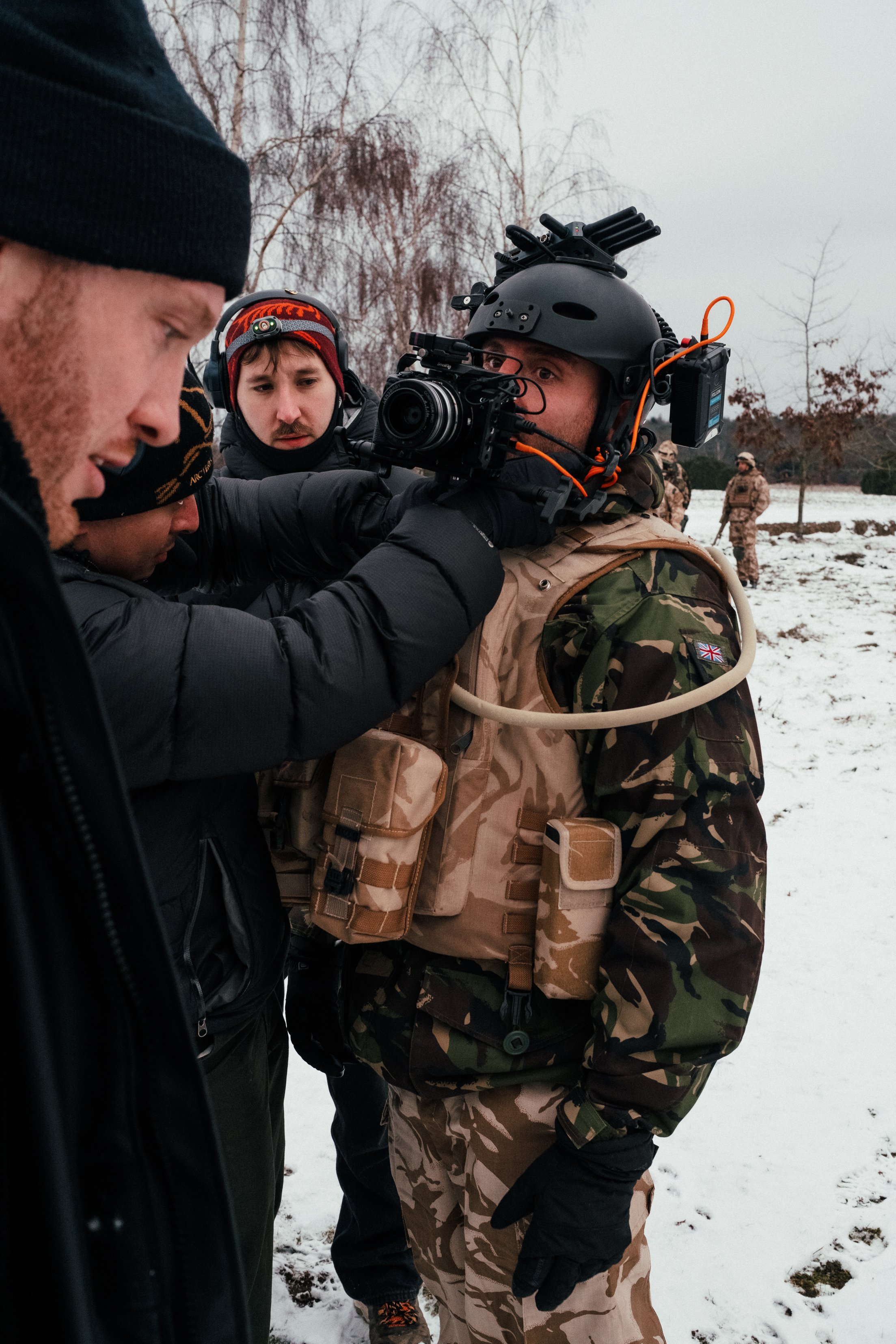
DOP Charles Clare and AC Mikey Sneddon adjust stunt coordinator Adam Collins’ Head mounted Camera.
POV shots might be overdone in a commercial world but they are essential for our story.
Field Notes: A few things that made our reenactment shoot work.
Last week we filmed one of the hardest sequences in Once We Were Warriors. A night-time reenactment of an IED strike in Afghanistan.
It was –6°C. Snow on the ground.Real veterans. Night vision, limited window of opportunity and funds but no shortcuts.
Here’s what actually made it work.
1. We didn’t chase spectacle, we chased memory.
It wasn’t about explosions or cinematic moments. And lets be honest, how many times have you watched a military film and thought the accuracy was miles off.
It was more about being a custodian of that experience and how it felt to be there: the fear, the confusion, the narrowing of attention. That’s where all the truth lives. We own a fleet of Sony cinema cameras and chose to shoot it our smallest, cheapest and light camera for speed and flexibility.
2. The conditions did half the directing. (It snowed, and we didn’t care.)
Cold, darkness, breath in the air, numb hands and field fingers. You can’t fake that how that feels. The environment forced everyone including cast and crew into the right headspace. I read in my Afghan diary it got to -7 on some nights so we weren’t far off. There’s no-one a hot drink and stretcher carry won’t warm up.
3. We limited the camera on purpose.
POV, night vision, handheld. No safety angles. No coverage as a crutch, though I did, and normally want options. The frame stayed trapped inside the experience, just like I was that night 18 years ago. The man who was injured on that night said during a take:
“That is exactly what I saw…)
4. The people on camera knew the reality.
This wasn’t actors pretending to be soldiers. It was men and women who have carried stretchers, taken contact, and lived with the aftermath. That weight shows. It’s a soldiers demeanour that you can’t teach, and we needed people who understood not only the physical but the mental weight and consequence of what we were trying to achieve.
5. We ran it like a military exercise , not a film shoot to get into the headspace and keep a sense of urgency.
MOD liaison. Risk assessments. Radios. Timings. Light discipline. Precision.
This isn’t the right approach for every shoot, because contrary to popular belief, not EVERYTHING the military do works but it paid off for us last week.
That’s why it feels real, and I know the crew nailed it and as debut directing actors and crew I couldn’t be more proud of everyone who came together for it. It’s taken a fair bit of planning obviously and navigating a traumatic event and turning into a cohesive scene takes tact and planning. Time will tell, but I am beyond happy as I sit here typing this.
James Malone
Once We Were Warriors / Palpa Films
